Fine-Tuning vs. RAG, Which Approach is Right for Your Business?
Your team built an AI assistant for customer support. It cost $80,000 to fine-tune the model on your historical tickets, took three months to deploy, and works beautifully for the first two quarters. Then your product lineup changes. Your pricing structure updates. Your support policies evolve. And suddenly your expensive, perfectly trained model is giving outdated answers that frustrate customers more than they help. That is the fine-tuning trap, and it is exactly why Retrieval-Augmented Generation exists.
The Old Way vs. The AI-First Way
The Old Way: Companies assume fine-tuning is the only path to making language models work for their specific business. You collect thousands of examples, spend weeks preparing training data, burn through compute resources, wait for model training to complete, then deploy a model that becomes stale the moment your business changes. Every update requires another fine-tuning cycle. More data preparation. More compute costs. More waiting.
The New Way: RAG connects language models to your live data sources without changing the model itself. When a customer asks a question, the system retrieves relevant information from your knowledge base in real time and uses that context to generate accurate, current responses. Your pricing changes? The model pulls the new pricing instantly. Your product catalog updates? The answers reflect those changes immediately. No retraining. No downtime. No stale information.
Here is the difference in practice: A financial services firm fine-tuned a model to analyze investment reports. Performance was excellent for six months. Then regulatory requirements changed, market conditions shifted, and new financial instruments launched. The model became unreliable. Switching to RAG meant the system pulled current SEC filings, latest earnings calls, and updated compliance rules dynamically, maintaining accuracy without constant retraining.
The Core Framework: Understanding When Each Approach Works
Both fine-tuning and RAG solve real problems. The key is knowing which problems they solve and when to use each.
Fine-Tuning Wins on Style, Tone, and Deep Patterns
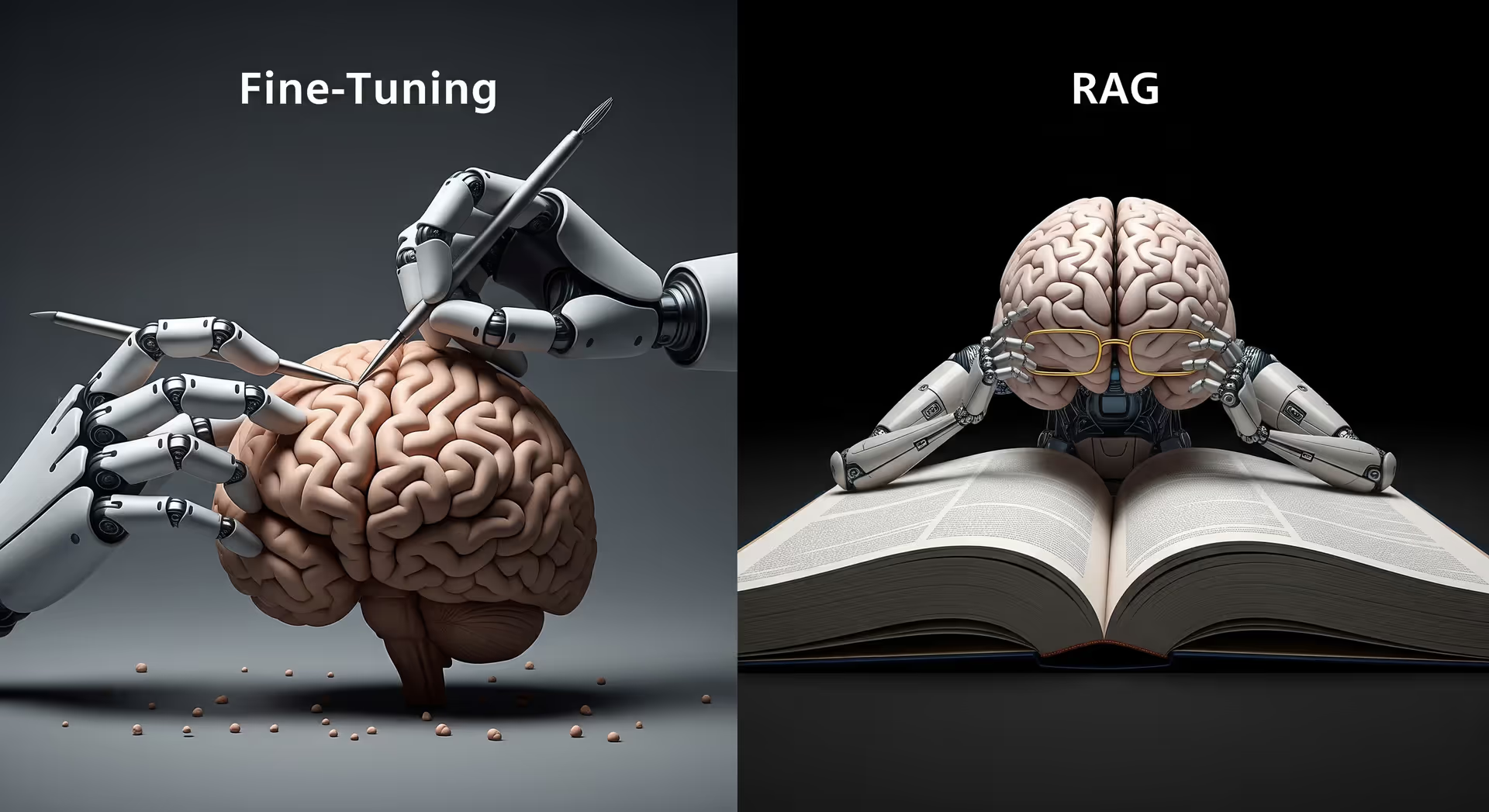
Fine-tuning modifies the model's internal parameters based on your training data. This makes it exceptional for tasks requiring consistent tone, specialized language patterns, or domain-specific reasoning that goes beyond factual recall. In mental health text analysis, fine-tuned models achieved 91 percent accuracy for emotion classification and 80 percent for condition detection, significantly outperforming base models at 40 to 68 percent accuracy.
When you need the model to sound like your brand, follow specific communication protocols, or apply nuanced judgment calls that require internalized expertise, fine-tuning delivers results. Medical diagnosis support tools, legal research copilots, and specialized customer service bots that must maintain regulatory compliance benefit from fine-tuning because the expertise needs to be embedded in the model itself.
RAG Wins on Currency, Flexibility, and Scale
RAG does not change the model. It changes what information the model can access when generating responses. This architecture excels when you need answers grounded in current, verifiable data that updates frequently. In Korean language tasks, RAG improved performance by 10.2 percent on reading comprehension and 32.3 percent on sentiment analysis compared to base models, without any fine-tuning.
For financial services KYC compliance, RAG systems analyze transaction patterns against historical fraud cases in real time, reducing fraud detection time by pulling the latest data rather than relying on patterns learned months ago during training. Portfolio managers accelerate investment research using AI that synthesizes current earnings calls and SEC filings, not historical snapshots frozen in training data.
Hybrid Approaches Deliver Maximum Performance
The most sophisticated implementations combine both. Studies show that RAG plus fine-tuning together improved performance by 11.5 percent to 41.9 percent compared to fine-tuning alone. You fine-tune for tone, reasoning patterns, and domain expertise. You add RAG for factual grounding and current information. A healthcare system might fine-tune for medical reasoning and communication style while using RAG to pull the latest clinical guidelines and patient records.
The Hard ROI: What Each Approach Actually Costs
The cost difference between fine-tuning and RAG is not just about compute bills. It is about time, flexibility, and long-term maintenance.
Fine-Tuning Economics
Fine-tuning a 7-billion parameter model requires substantial computational resources. Depending on dataset size and complexity, initial fine-tuning costs range from $5,000 to $50,000 in compute alone. Add data preparation time, machine learning engineer hours at $150 to $250 per hour for 200 to 400 hours, and total first deployment costs hit $35,000 to $150,000.
The hidden cost is maintenance. Every significant business change requires retraining. New products launch? Retrain. Policies update? Retrain. Market conditions shift? Retrain. Each iteration adds $10,000 to $30,000 and two to four weeks of lag time. For fast-moving businesses, this creates a permanent accuracy gap between reality and what your model knows.
RAG Economics
RAG infrastructure costs break down differently. You need vector databases for embedding storage, costing $500 to $3,000 monthly depending on scale. Retrieval systems add compute overhead, typically 15 to 30 percent more than base model inference. But there are no retraining cycles. Updates to your knowledge base happen in real time at zero marginal cost beyond storage.
For a company making 1 million LLM calls monthly, RAG adds roughly $2,000 to $5,000 in infrastructure costs. Compare that to quarterly fine-tuning cycles at $40,000 each, totaling $160,000 annually, and RAG delivers 70 to 85 percent cost savings while maintaining higher accuracy on current information.
Time-to-Value Comparison
Fine-tuning takes weeks to months from data collection to deployment. RAG can be operational in days. For businesses where speed matters, that difference is strategic. A retail company implementing RAG for product recommendations can deploy, test, and iterate in one week. The same company choosing fine-tuning faces an eight-week timeline before seeing results.
Tool Stack and Implementation Decisions
Choosing between fine-tuning and RAG is not binary. The decision framework depends on your specific use case.
Use Fine-Tuning When:
Your primary need is consistent tone, style, or specialized language patterns. Regulatory compliance requires auditable reasoning embedded in the model. Your domain expertise cannot be easily documented or retrieved, requiring internalized understanding. Your data is relatively stable, not changing daily or weekly. You have budget for ongoing retraining cycles and machine learning engineering resources.
Use RAG When:
Your information updates frequently and accuracy depends on current data. You need verifiable, traceable answers with source citations. Your knowledge base is large, diverse, and constantly expanding. You want rapid deployment without weeks of model training. You need to control exactly what information the model can access for compliance or security reasons.
Implementation Frameworks for RAG
LangChain and LlamaIndex are the dominant RAG frameworks in 2025, offering pre-built connectors to vector databases like Pinecone, Weaviate, and Chroma. These frameworks handle document chunking, embedding generation, similarity search, and context injection with minimal custom code.
For enterprises prioritizing data governance, implementing RAG with on-premises vector databases ensures sensitive information never leaves your infrastructure while maintaining the flexibility RAG provides.
Implementation Frameworks for Fine-Tuning
Parameter-Efficient Fine-Tuning methods like LoRA reduce compute requirements by 60 to 80 percent compared to full fine-tuning while maintaining comparable performance. Platforms like Hugging Face provide accessible fine-tuning pipelines, and cloud providers offer managed fine-tuning services that abstract infrastructure complexity.
Making the Decision: A Practical Framework
Start by asking three questions:
1. How often does your underlying information change?
If the answer is daily or weekly, RAG wins. If the answer is quarterly or annually, fine-tuning becomes viable.
2. Do you need specialized reasoning or just accurate retrieval?
If you need the model to think like a domain expert with nuanced judgment, fine-tune. If you need it to find and present correct information, use RAG.
3. What is your acceptable lag time between business changes and model accuracy?
If you cannot tolerate even one-week gaps between updates and model knowledge, RAG is mandatory. If monthly accuracy updates suffice, fine-tuning works.
Most businesses will land on hybrid implementations: fine-tune for domain expertise and communication style, use RAG for factual grounding and current information. This combination achieved 85.8 percent accuracy in complex reasoning tasks, outperforming both approaches used independently.
The companies winning with AI are not choosing between fine-tuning and RAG. They are strategically deploying both where each excels, creating systems that combine deep domain expertise with real-time factual accuracy. Stop thinking either/or. Start thinking when and where for each approach.
Evaluate one AI use case in your business today. Map whether the core requirement is specialized reasoning or current information retrieval. Then deploy the right tool for that specific job.
Related Topics
Related Articles