Virtual Influencers: The Future of Brand Representation?
Everyone is talking about AI influencers like they are the next marketing miracle. But here is what nobody tells you: brands are spending 30% less and getting 46 times less reach per post compared to human influencers. The math does not add up the way most agencies want you to believe.
The global virtual influencer market hit $6.33 billion in 2024 and is projected to explode to $111.78 billion by 2033. That is a 38.4% compound annual growth rate. Companies like Prada, Calvin Klein, and Dior are betting millions on CGI personalities with zero human DNA. The question is not whether virtual influencers are here. The question is whether they actually work.
The Old Way vs. The AI-First Way
The Old Way (Human Influencer Model):
Most brands still operate on the traditional influencer playbook. They pay $50 to over $1 million per post depending on follower count. They deal with travel costs, accommodation, production logistics, and the constant risk of PR disasters when their influencer says something controversial at 2 AM. Human influencers average 414,754 likes per post and command premium fees because they deliver authentic engagement. But they also come with scheduling conflicts, creative disagreements, and the reality that they are human beings with opinions.
The New Way (Virtual Influencer Model):
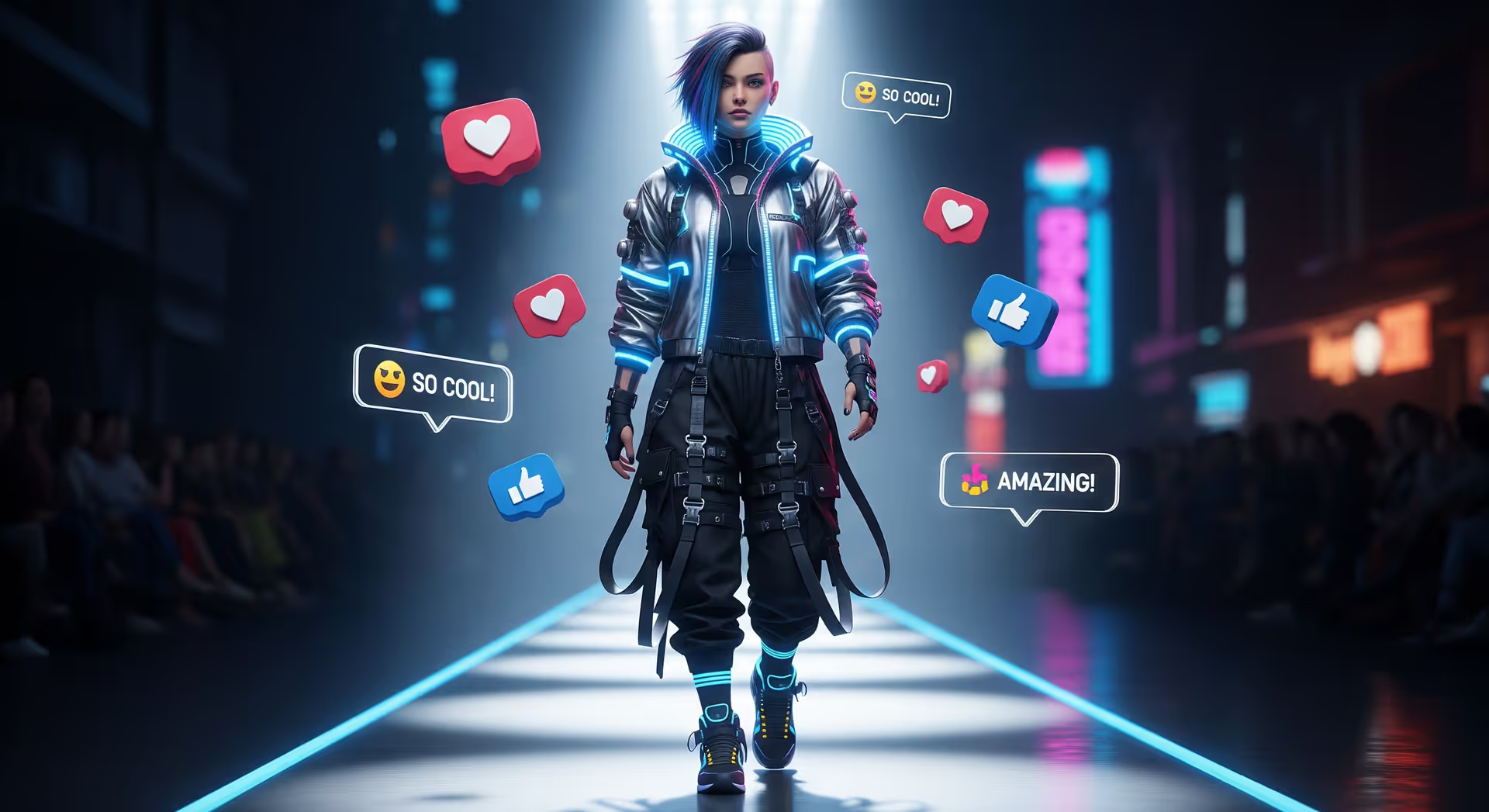
Top 1% brands are now building CGI influencers from scratch. Lil Miquela partnered with 91 brands in 12 months and reached 9.9 million users with an estimated media value of $219,000. Noonoouri collaborated with 130 brands, reached 31.9 million users, and generated $771,000 in media value. These digital personas work 24/7, never age, never get sick, and never refuse a campaign. Virtual influencers deliver 2.84% engagement rates compared to 1.72% for human influencers. Some campaigns hit 5.9% engagement rates, which is three times higher than real influencer campaigns at 1.9%.
But here is the brutal truth: virtual influencers average only 71,491 likes compared to human influencers at 414,754 likes. You are trading massive reach for control and cost efficiency.
The Core Framework: When Virtual Influencers Actually Work
Virtual influencers are not a replacement strategy. They are a supplement strategy. Here is how the top brands deploy them:
Phase 1: Brand Control Campaigns
Use virtual influencers for product launches where messaging must be precise and risk-free. Prada created their virtual influencer Candy for fragrance marketing. Result: 35% increase in engagement among millennial luxury shoppers and a 15% rise in fragrance sales. No off-brand comments. No scheduling issues. Total creative control.
Phase 2: Cross-Platform Saturation
Deploy virtual influencers across Instagram, TikTok, augmented reality experiences, and metaverse activations simultaneously. Calvin Klein partnered with Lil Miquela and reached 12 million unique users with 12% higher engagement than traditional campaigns. One digital persona can appear in five different campaigns across three continents on the same day without a plane ticket.
Phase 3: Long-Term Brand Assets
Build proprietary virtual influencers that become brand mascots. Unlike human influencers who age out or move to competitors, virtual influencers are owned assets. Noonoouri focuses on sustainability and digital haute couture, aligning perfectly with luxury brand values for years without renegotiating contracts.
Phase 4: Hybrid Campaigns
Combine virtual and human influencers in the same campaign. Use humans for authentic storytelling and emotional connection. Use virtual influencers for high-volume content production and brand consistency. This is where ROI peaks.
The Hard ROI: Where the Money Actually Moves
Let me break down the real numbers because everyone talks about engagement rates but nobody talks about cost per acquisition.
Cost Reduction: Brands replacing human influencers with AI cut campaign expenses by 30%. A human influencer charging $100,000 per campaign with travel, production, and logistics costs becomes a $70,000 virtual campaign with zero ongoing fees.
Time Savings: Virtual influencers eliminate negotiation cycles, scheduling conflicts, and approval delays. If you run 12 campaigns per year and save 40 hours per campaign in coordination time, that is 480 hours annually. At $200 per hour for your marketing team, you save $96,000 in labor costs alone.
Lifespan Value: A human influencer partnership lasts 1 to 3 years on average before they move on or lose relevance. A virtual influencer is a perpetual asset. Build once, deploy forever. If you spend $500,000 creating a high-quality virtual influencer and use them for 10 years across 120 campaigns, your cost per campaign is $4,166. Compare that to paying a human influencer $50,000 per campaign for the same 120 campaigns, which totals $6 million.
Engagement Arbitrage: Virtual influencer campaigns hit 5.9% engagement rates in specific verticals like fashion and tech. If your customer acquisition cost is $50 via traditional ads and a virtual influencer campaign drops it to $35 due to higher engagement, you save $15 per customer. At 10,000 customers per year, that is $150,000 in pure savings.
But here is the other side: human influencers still make 46 times more money per post because they drive higher absolute reach. If your goal is maximum visibility, humans win. If your goal is cost-efficient, controlled, repeatable campaigns, virtual wins.
Tool Stack: What You Actually Need to Build This
Most agencies will try to sell you expensive custom builds. Here is what the top brands actually use:
AI Character Creation: Tools like Midjourney, Stable Diffusion, and proprietary 3D modeling software create the base character. Cost ranges from $50,000 to $500,000 depending on quality and animation complexity. High-end virtual influencers like Noonoouri are fully animated CGI models requiring motion capture and rendering pipelines.
Content Production: Use platforms like ChatGPT for caption writing and content strategy. Pair with Adobe Creative Suite for post-production. The key is creating a consistent visual style and voice across all posts.
Campaign Management: Make.com or Zapier automate posting schedules across Instagram, TikTok, YouTube, and LinkedIn. Set up workflows so one content approval triggers distribution across all platforms simultaneously.
Analytics and Optimization: Track engagement with native platform analytics plus tools like Storyclash or Influencer Marketing Hub. Virtual influencers generate massive data because every interaction is trackable without privacy concerns that limit human influencer data.
Why These Tools: Make.com is better for visual workflows and multi-step automations. ChatGPT handles the creative heavy lifting for captions and engagement replies. Adobe Creative Suite ensures your virtual influencer maintains visual consistency, which is critical for believability.
The real differentiator is not the tools. It is the strategy behind deployment. Brands fail when they treat virtual influencers like novelty gimmicks. Brands win when they deploy them as long-term brand assets with clear ROI targets.
The Bottom Line
Virtual influencers are not replacing humans. They are creating a new category where brands can own their influence instead of renting it. The market is moving from $6.33 billion in 2024 to $111.78 billion by 2033 because CFOs are looking at the 30% cost reduction and the elimination of PR risk.
But if you think you can just spin up a CGI model and watch the money roll in, you are going to waste six figures. Virtual influencers work when you have a clear content strategy, consistent visual identity, and campaigns designed for control and repeatability over viral reach.
Do not just read this. Go audit your current influencer spend. Calculate how much you are paying per post, per campaign, and per customer acquired. Then model what a hybrid approach with one virtual influencer could save you over three years. If the numbers do not justify the upfront investment, stick with humans. If they do, build your first virtual influencer this quarter and test it in one vertical before scaling.
The future is not virtual or human. The future is strategic deployment of both based on what the math tells you to do.
Related Topics
Related Articles